Roof Repairs
Repairs across Parramatta, where failing box gutters and brittle original terracotta cause most of the water damage.
Learn more →Colorbond and steel roofing in Parramatta: tile-to-metal conversions, re-sheets, low-pitch infill roofs and flashings. Free inspection and quote.
Repairs across Parramatta, where failing box gutters and brittle original terracotta cause most of the water damage.
Learn more →Re-roofing Federation and inter-war homes across Parramatta, plus the rear additions built over them.
Learn more →Restoration for Parramatta tile roofs where the terracotta is sound but the pointing and bedding have perished.
Learn more →Box gutter, eaves gutter and downpipe work across Parramatta, the most common cause of ceiling damage on older homes here.
Learn more →Storm response across Parramatta and Granville after hail or heavy runoff, with a same-day make-safe where we can.
Learn more →Roof inspections and written reports across Parramatta for pre-purchase, strata and insurance use.
Learn more →The steel roof is now the default in Parramatta anywhere the heritage rules do not say otherwise. Drive the new townhouse rows at Rydalmere or Telopea and it is sheet steel end to end; drive the post-war streets of Greystanes or Pendle Hill and you will see a tile roof with a steel neighbour on either side, both of them originally identical.
Whether that is the right move for your house depends on the roof form, the pitch and what the council expects of your street. Call (02) 9090 4741 and we will come and look.
Tile still wins on some counts — thermal mass, acoustic mass, and matching a heritage streetscape. We are not going to tell you steel is always better.
Corrugated. The familiar wavy profile. Suits traditional and cottage forms, handles curves, and is the easiest match to a pre-war outbuilding. Needs the most pitch.
Trapezoidal rib (Trimdek-style). Flatter pans, stronger ribs, pierce-fixed through the crest with sealing washers. The workhorse for suburban re-roofs and additions across Merrylands, Wentworthville and Guildford.
Concealed-fix tray (Kliplok-style). No screws through the sheet at all — the pans clip to concealed fixings. Fewer penetrations means fewer future leak points, and it runs at the lowest pitch of the three. This is what usually goes on the near-flat rear sections and on modern infill.
Standing seam and architectural trays. Mostly on new builds and renovations where the roof is part of the design rather than just a cover.
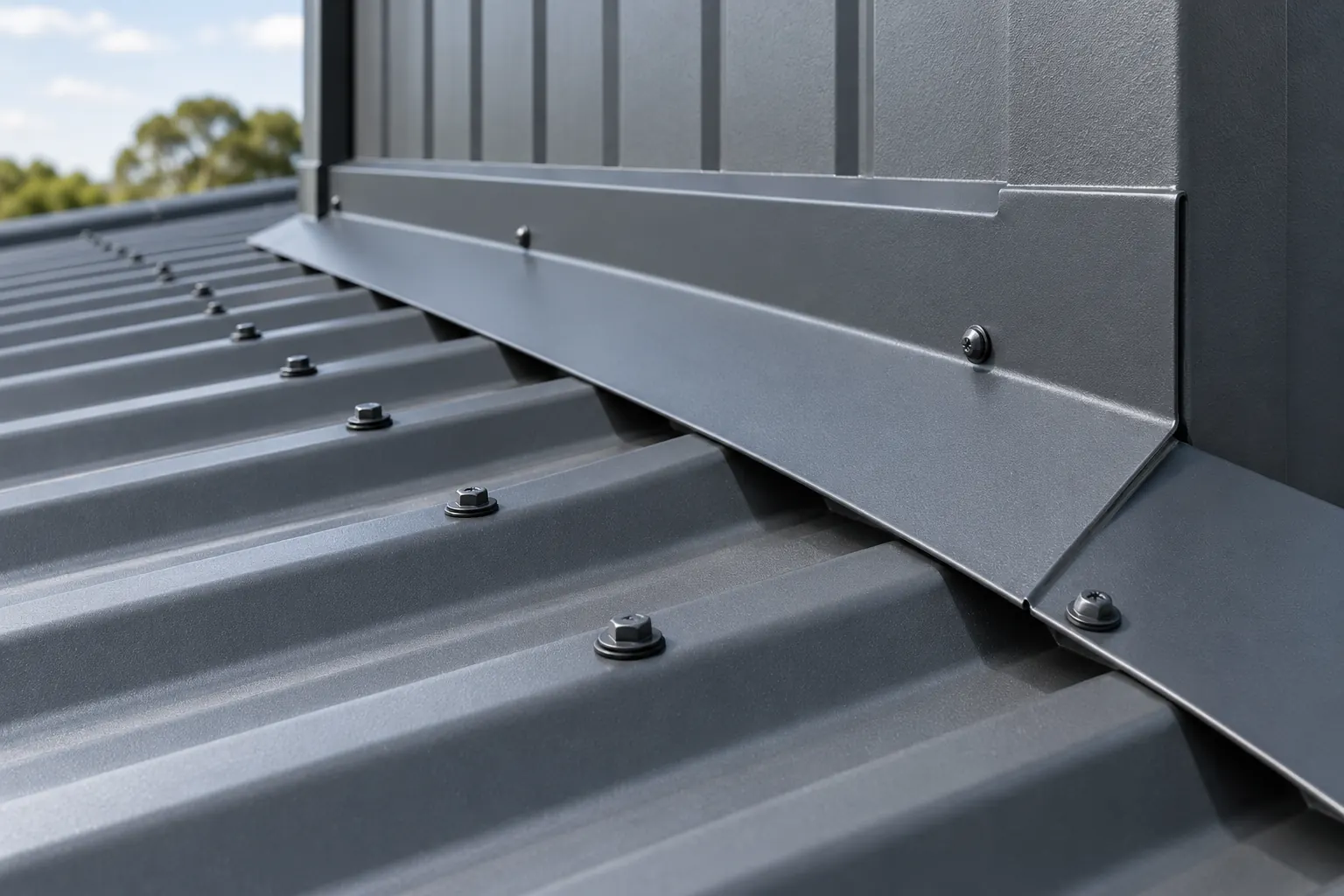
A tile-to-metal conversion is not a swap of surface. Underneath, nearly everything changes:
This is the part that gets overlooked on western Sydney re-roofs. A sealed, well-insulated sheet roof over a house with a lot of internal moisture — bathrooms, laundry, cooking, a few people and the doors shut on a cold night — will form condensation on the underside of the sheet if there is nowhere for the vapour to go. It drips, and the owner calls a roofer about a leak that is not a leak.
The fix is designed in at the start: a vapour-permeable sarking, a ventilated ridge or roof-space ventilators, and clear eave intake. It costs very little at installation and is expensive to retrofit.
City of Parramatta has 18 heritage conservation areas, and several of them sit squarely over the suburbs where terracotta roofs are the defining feature — North Parramatta, Sorrell Street and South Parramatta, Experiment Farm and Harris Park West in Harris Park, Elizabeth Farm at Rosehill, Burnside Homes at Oatlands, Tottenham Street at Granville. In those areas the local environmental plan generally requires consent before the external appearance of a building is changed, and replacing terracotta with painted steel is unambiguously a change of appearance.
South of the line, Cumberland City Council runs its own controls across Merrylands, Guildford, Greystanes, Auburn, Girraween and the rest. Either way, the question to settle before you pick a colour is whether your property is in a conservation area or is a listed item. We will raise it if your address looks likely; we are not a substitute for Council.
Darker roofs in western Sydney get hot, and Parramatta runs hotter than the coastal suburbs on a summer afternoon — the Cumberland Plain has no sea breeze to speak of until late in the day. A lighter or solar-reflective finish over a decent insulation blanket makes a measurable difference to the ceiling temperature in an upstairs bedroom. Charcoal looks sharp and is enormously popular; just put the insulation behind it.
Roof area and pitch, profile choice, the number of penetrations and flashings, access, and whatever the strip reveals in the framing. A simple hip roof over a single-storey brick home in Girraween is a different job to a two-storey with three valleys, a parapet and skylights in Oatlands. We price after the inspection, in writing, itemised.
Call (02) 9090 4741 or tell us about the roof. If sheet is not the right answer for your house we will say so, and point you at restoration or a like-for-like replacement instead. We work right across the Parramatta area.
Less than people expect, and the difference is almost entirely in what sits under it. Sarking with a bonded blanket, plus insulation in the ceiling, takes most of the drum out of heavy rain and hail. A bare sheet over open battens with nothing behind it is loud. Ask what blanket and sarking are in the quote, because that line item is the one that decides how the roof sounds.
Usually, but the profile has to suit the fall. Standard corrugated needs more pitch than people assume; a concealed-fix tray profile runs much lower and has far fewer penetrations to leak through. Below the minimum pitch for any profile, you are into a membrane or a properly designed box-gutter arrangement instead. We measure the actual fall rather than guessing from the ground.
Only where heritage controls apply, and in Parramatta that is a real consideration. North Parramatta, Sorrell Street, South Parramatta, Experiment Farm and Harris Park West are among the 18 heritage conservation areas in the City of Parramatta, and changing the external appearance of a building in one generally requires consent. Outside those areas, in most of Merrylands, Greystanes, Toongabbie and the post-war belt, material choice is yours.
Differently to tile rather than better in every respect. Hail dents steel and can mark the paint finish, but it does not usually breach the sheet, so the roof keeps working. The same stone cracks a brittle terracotta or an aged concrete tile and opens a water path straight away. Insurers treat the two outcomes very differently, which is worth knowing before a claim.
Zincalume is the aluminium-zinc coated steel base. Colorbond is that same base with a baked-on paint system over it, which is what gives you the colour range and the extra surface protection. Plain galvanised is the older zinc-only coating you still find on sheds and pre-war outbuildings around Granville and Clyde. For a house roof in this area, a painted finish over Zincalume base is the standard specification.
Tell us what you need and we'll get straight back to you. Prefer to talk? Call (02) 9090 4741 and speak to someone local.
Call (02) 9090 4741